Important Distinguish test of Function Groups (12 Board Exam) Click Here

Answers are given in the end-

1. How will you distinguish butanol, butan-2-ol and 2-Methylbutan-2-ol

2. How will you distinguish aniline and phenol?

3.How will you distinguish phenol and ethanol?

4.How will you distinguish ethanamine and N-Methyl methanine.

5.How will you distinguish Propanamine and N,N-Dimethylethanamine.

6.How will you distinguish Propanamine, N-Methyethanamine and N,N-Dimethylmethanamine.

7. How will you distinguish Ethanol and Ethanoic acid.

8.How will you distinguish Methanal and Ethanal?

9.How will you distinguish Propanal and Propanol.

10.How will you distinguish Propanol and Ethanol?

11.How will you distinguish Choloromethane and Chlorobenzene.

Answer-
1.When Licas reagent (ZnCl2 + HCl ) is added than turbidity appears immediately in Methylbutan-2-ol ( tertiary alcohol), turbidity appears after 5 minutes in butan-2-ol ( Secondary alcohol) and no turbidity appears in butanol ( Primary alcohol).

2.Phenol gives violet colour with neutral FeCl3 while aniline does not.

3.Ethanol gives red colour with ceric ammonium nitrate while phenol does not.

4.Ethanamine reacts with benzenesulphonyl chloride( Hinesburg’s Reagent) which is soluble in dilute solution of NaOH, whereas N-Methyl methanine reacts but insoluble in dilute solution of NaOH.

5.Propanamine reacts with benzenesulphonyl chloride ( Hinesburg’s Reagent) which is soluble in dilute solution of NaOH, whereas N,N-Dimethylethanamine does not react.

6.Propanamine reacts with benzenesulphonyl chloride ( Hinesburg’s Reagent) which is soluble in dilute solution of NaOH whereas N-Methyl ethanine reacts but insoluble in dilute solution of NaOH whereas N,N-Dimethylethanamine does not react.

7.Ethanol gives red colour with ceric ammonium nitrate while Ethanoic acid does not.
Or Ethanol gives frutty smell of esters with ethanoic acid and few drops of conc. H2SO4 whereas ethanoic acid does not. (Note- This is ester test)

8.Ethanal gives yellow ppt with a mixture of NaOH and I2 while methanol does not ( Iodoform,s Test)

9.Propanal gives silver mirror or black ppt with Tollen,s reagent( AgNO3 + NH4OH) while Propanol does not.
Or Propanal gives red ppt with mixture of Fehling,s solution A ( solution of CuSO4) and B ( solution of sodium potassium tartarate and NaOH) while Propanol does not.
( Note- Aldehydes gives Tollens test and Fehling,s solution test while ketones does not.)

10.Ethanol gives yellow ppt with a mixture of NaOH and I2 while propanol does not (Note-This is Iodoform,s Test given by compounds having three alpha hydrogen to carbonyl group or three beta hydrogen to alcoholic group)

11.Choloromethane gives white precipitate with AgNO3 but Chlorobenzene does not.

Biomolecules (XII Std)-Important and conceptual Questions

Answer are given in the end–

Questions useful in Board Examination.

1.What is basic unit of carbohydrates?

2.What is basic unit of protein or polypeptide?

3.What is the non reducing sugar and what is cause of it?

4.What do you mean primary structure of protein ?

5. What do you mean secondary structure of protein ?

6.What do you mean tertiary structure of protein ?

7.What is native structure of protein?

8.What is zwitter ion.

9.Which vitamins are fat soluble?

10.What is importance of primary structure of protein?

Answers-

1.Glycosidic Linkages

2.Peptide bond

3.The sugar which reduces Tollen,s reagents or Fehling,s solution is called reducing sugar. It is because their carbonyl functions are not free.

4.The specific sequence of amino acid in protein is called primary structure of protein.

5.Alpha halix or beta pleated sheet are secondary structure of protein which is stabilized by hydrogen bonds. alpha helix is a helical structure whereas beta pleated sheet is formed by placing primary structure sidewise.

6.Tertiary structure of protein is formed by overlapping and folding of primary and secondary structure of over each other. Tertiary structure is stabilized by following bonds-
1) Hydrogen bond formed between -NH2 group and C=O group of different part of polypeptide chain.
2) Ionic bond formed between -NH3+ and COO groups of different part of polypeptide chain.
3) Disulphide bond -S-S- between different part of polypeptide chain.
4) Hydrophobic bond is not actual type of bond but it is a condition in which nonpolar hydrophobic chains moves inside the protein.

7. The original and active shape of protein at particular pH range and temperature range is called native state of Protein.

8.The bipolar ion of amino acid is called zwitter ion.

9.Vitamins A , D , E and K are fat soluble.

10.The change only in one amino acid in polypeptide chain changes property also. Example-In sickle cell anemia is an inherited disease which affect red blood cell and change it into sickle shaped. It is due to change in only one amino acid i.e. glutamic acid by valine in the polypeptide chain making hemoglobin.

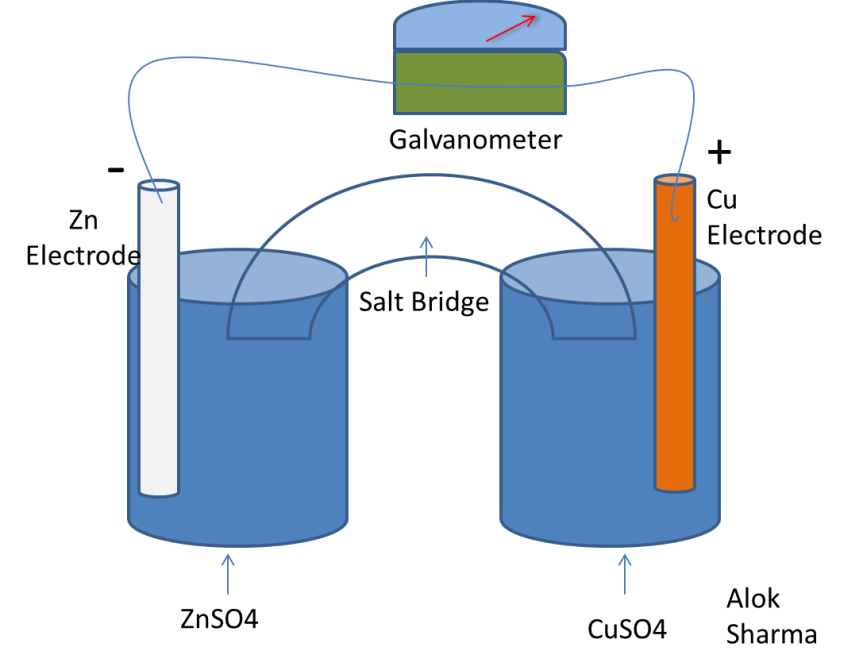
Electrochemistry(XII Std) Important Questions Answers

Answers are given in the end

1.What is NFE/SHE ?

2.Explain the variation of conductivity with dilution. or How does conductivity varies with dilution ? Explain the reason for the variation ?

3.Explain the variation of molar conductivity of weak electrolyte with dilution. or How does conductivity of weak electrolyte varies with dilution ? Explain the reason for the variation ?

4.Explain the variation of molar conductivity of strong electrolyte with dilution. or How does conductivity of strong electrolyte varies with dilution ? Explain the reason for the variation ?

5.Explain Kohlrausch law

6.Calculate the Vont hoff’s factor for K4[Fe{CN)6] .

7.What is cell constant ?

8.Why can’t molar conductivity at infinite dilution of weak electrolyte be measured using graphical method ?

9.What are the secondary cells?

10. What are the fuel cells?

11.State advantages and disadvantages of fuel cells.

Answers- 1.The hydrogen electrode at 298 K with pressure of hydrogen is 1 bar and concentration of hydrogen is 1 M is called Standard Hydrogen Electrode / Normal Hydrogen Electrode.         2.Conductivity decrease with dilution because number of ions decreases per unit volume with dilution. ( Conductivity is the conductance of solution of unit volume/ one litre.                3. Molar conductivity of weak electrolyte increases with dilution due to increase in degree of dissociation.  4.Molar conductivity of strong electrolyte increases with dilution due to decrease in interionic attraction as interionic distance increase with dilution.  5.At infinite dilution molar conductivity of weak electrolyte is sum of contribution of molar conductivities of cations and anions which are independent of each other. 6. Von,t Hoff factor = 5/1 =5.  7. Cell constant is the ratio of length between vs area of electrode = L / A 8.Because line of graph never touch molar conductivity axes. 9.The cell which can be reuse again and again by charging. 10. The cell which generate energy from fuel without burning it , is called fuel cell. 11. Advantage of fuel cell-(1) It is pollution free (2) Continuous source of electricity (3) byproduct is water. Disadvantages of fuel cell- It is costly as catalysts is costly.

d and f Block Elements – Important Questions and Answers

1. Why are transition metals ions are coloured ?

2.Transitions metals are good catalyst. Why ?

3.Transition metals form alloy. Why ?

4. Why is a dip at Mn in the graph of melting point verses atomic number ?

5. What is lanthanoid contraction ?

ANSWER-

  1. due to d-d transition
  2. A. Due to having variable valences B. Due to having free valencies on surface.
  3. Due to having similar atomic sizes.
  4. Due to weak metallic bond beacuse of half filled electronic configuration.
  5. Decrease in the atomic size of Lanthanoids with atomic number