Amines (12 Std) Important and Conceptual questions

Answers are given in the end-

1.Amines are basic in nature . Why?

2.Arrange the following amines in decreasing order of their basic strength. Give reason also.

 (CH3)3N > (CH3)2NH > CH3NH2 >  NH3 In aqueous phase

3. Arrange the following amines in decreasing order of their basic strength. Give reason also.

 C2H5NH2 > (C2H5)2NH > (C2H5)3N > NH3 In aqueous phase

4. Arrange the following amines in decreasing order of their basic strength. Give reason also.

 (CH3)2NH > (CH3)3N > CH3NH2 > NH3 in gaseous phase

5.Arrange the following amines in decreasing order of their basic strength. Give reason also.

6. Methanamine is less basic than aniline. Why?

7.Anilene does not gives friedal craft,s reaction.Why?

8.Why does amine group is protected by acetylating it?

9. Explain briefly

(a) Carbylamine reaction( Isocyanide test)

10. pKb value of ethylamine is lower than benzylamine

Answer

1.Basic nature of amine is attributed to presence of lone pair of electron on nitrogen atom of amine group which can be donated.

2. (CH3)2NH >  CH3NH2 > (CH3)3N > NH3 (This order is combine effect of three factors.In aqueous phase, inductive effect, solvation effect and steric hindrance also play important roles)

3.(C2H5)2NH > (C2H5)3N > C2H5NH2 > NH3  (This order is combine effect of three factors.In aqueous phase, inductive effect, solvation effect and steric hindrance also play important roles)

4. (CH3)3N > (CH3)2NH > CH3NH2 > NH3  ( Due to Steric hinderance increases from primary to tertiary amine which hinder to donate lone pair of electron.)

5.

Methyl group, having +I effect increases the electron density on Nitrogen of amine whereas electron withdrawing(-I and –M effect) nitro group decreases electron density on nitrogen of benzene ring.

6.Due to +I effect of methyl group electron density increases in N of amine group whereas electron density decreases due to involvement of lone pair of electrons in resonance.

7. Because basic group amine (-NH2) reacts with friedal craft,s reagents which is acidic in nature and nitrogen bears +ive charge. This +vely charged nitrogen deactivate to the benzene ring due to its elecrtron withdrawing effect.

8. Amine group is protected by acetylating ( addition of -COCH3) it therefore it does not react with friedal craft,s reagens and able to perform friedal craft reaction.

9.When primary amine is treated with chloroform (CHCl3) in presence of base (KOH) yields isocyanide having offensive smell.

R-NH2  + CHCl3 +3 KOH  –>  R-NC + 3KCl  + H2O

10.( pKb value lower mean basic strength is higher) Due to +I effect of ethyl group electron density increases in N of amine group, therefore ethamine is more basic whereas aniline is less basic as electron density decreases due to involvement of lone pair of electrons in resonance.

Biomolecules (XII Std)-Important and conceptual Questions

Answer are given in the end–

Questions useful in Board Examination.

1.What is basic unit of carbohydrates?

2.What is basic unit of protein or polypeptide?

3.What is the non reducing sugar and what is cause of it?

4.What do you mean primary structure of protein ?

5. What do you mean secondary structure of protein ?

6.What do you mean tertiary structure of protein ?

7.What is native structure of protein?

8.What is zwitter ion.

9.Which vitamins are fat soluble?

10.What is importance of primary structure of protein?

Answers-

1.Glycosidic Linkages

2.Peptide bond

3.The sugar which reduces Tollen,s reagents or Fehling,s solution is called reducing sugar. It is because their carbonyl functions are not free.

4.The specific sequence of amino acid in protein is called primary structure of protein.

5.Alpha halix or beta pleated sheet are secondary structure of protein which is stabilized by hydrogen bonds. alpha helix is a helical structure whereas beta pleated sheet is formed by placing primary structure sidewise.

6.Tertiary structure of protein is formed by overlapping and folding of primary and secondary structure of over each other. Tertiary structure is stabilized by following bonds-
1) Hydrogen bond formed between -NH2 group and C=O group of different part of polypeptide chain.
2) Ionic bond formed between -NH3+ and COO groups of different part of polypeptide chain.
3) Disulphide bond -S-S- between different part of polypeptide chain.
4) Hydrophobic bond is not actual type of bond but it is a condition in which nonpolar hydrophobic chains moves inside the protein.

7. The original and active shape of protein at particular pH range and temperature range is called native state of Protein.

8.The bipolar ion of amino acid is called zwitter ion.

9.Vitamins A , D , E and K are fat soluble.

10.The change only in one amino acid in polypeptide chain changes property also. Example-In sickle cell anemia is an inherited disease which affect red blood cell and change it into sickle shaped. It is due to change in only one amino acid i.e. glutamic acid by valine in the polypeptide chain making hemoglobin.

Electrochemistry(XII Std) Important Questions Answers

Answers are given in the end

1.What is NFE/SHE ?

2.Explain the variation of conductivity with dilution. or How does conductivity varies with dilution ? Explain the reason for the variation ?

3.Explain the variation of molar conductivity of weak electrolyte with dilution. or How does conductivity of weak electrolyte varies with dilution ? Explain the reason for the variation ?

4.Explain the variation of molar conductivity of strong electrolyte with dilution. or How does conductivity of strong electrolyte varies with dilution ? Explain the reason for the variation ?

5.Explain Kohlrausch law

6.Calculate the Vont hoff’s factor for K4[Fe{CN)6] .

7.What is cell constant ?

8.Why can’t molar conductivity at infinite dilution of weak electrolyte be measured using graphical method ?

9.What are the secondary cells?

10. What are the fuel cells?

11.State advantages and disadvantages of fuel cells.

Answers- 1.The hydrogen electrode at 298 K with pressure of hydrogen is 1 bar and concentration of hydrogen is 1 M is called Standard Hydrogen Electrode / Normal Hydrogen Electrode.         2.Conductivity decrease with dilution because number of ions decreases per unit volume with dilution. ( Conductivity is the conductance of solution of unit volume/ one litre.                3. Molar conductivity of weak electrolyte increases with dilution due to increase in degree of dissociation.  4.Molar conductivity of strong electrolyte increases with dilution due to decrease in interionic attraction as interionic distance increase with dilution.  5.At infinite dilution molar conductivity of weak electrolyte is sum of contribution of molar conductivities of cations and anions which are independent of each other. 6. Von,t Hoff factor = 5/1 =5.  7. Cell constant is the ratio of length between vs area of electrode = L / A 8.Because line of graph never touch molar conductivity axes. 9.The cell which can be reuse again and again by charging. 10. The cell which generate energy from fuel without burning it , is called fuel cell. 11. Advantage of fuel cell-(1) It is pollution free (2) Continuous source of electricity (3) byproduct is water. Disadvantages of fuel cell- It is costly as catalysts is costly.

Camphor (कपूर):- Formula, Structure, Source, Uses & Preparation

Advertisements

Camphor:-
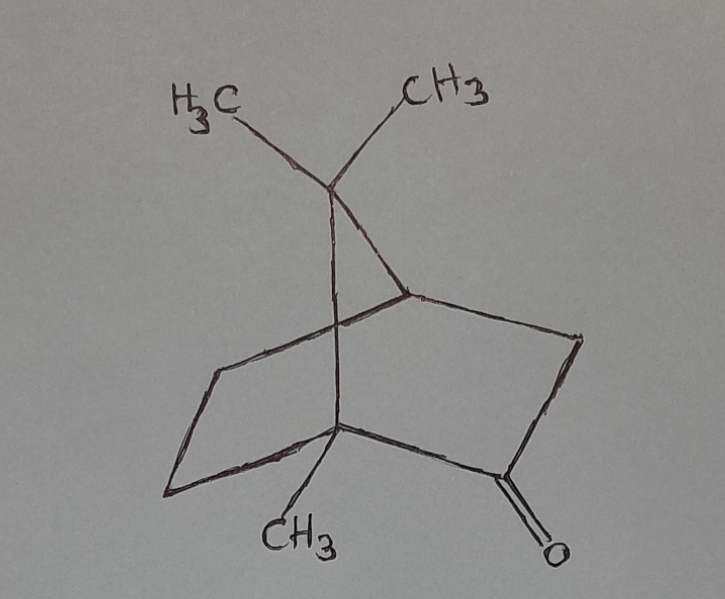
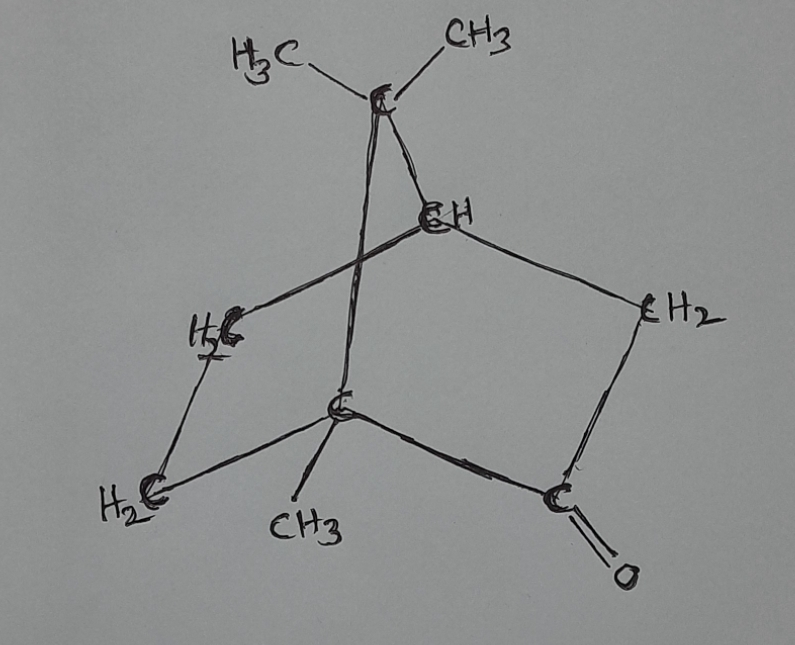
Formula:-( C10H16O )
Structure:-
bicyclic ketone ( Bicyclic means compounds containing two rings.)
Ketones is a functional group, in which one carbon has double bond with one oxygen and one-one single bond with other carbon atom.

Uses:-
1. It is burnt in worship.
2.As disinfectant, It produce lumps of carbon atoms which adsorb micro organism, particles of good or bad smell.
3.used on the skin as a painkiller in concentrations of 3% to 11%.
4.Camphor is used in many rub-on products to reduce pain related to cold sores, insect stings and bites, minor burns, and hemorrhoids.
5.It is used as one component of “amritdhara”
which is used to apply on forehead to relieve from headache.
6. It is used in products such as Vicks Vapo Rub.
7.Warning:-Oral camphor is unsafe. It is also important not to apply camphor to broken skin, because it can enter the body quickly and reach concentrations that are high enough to cause poisoning.
Source:-
1. Camphor is present in the volatile oils of camphor obtained from tree- Cinnamomum camphora ( Botanical Name ), or Camphor laurel
2.These days, camphor is usually manufactured from turpentine oil.
Process of making:- Camphor is obtained by using steam distillation of wood, twigs and bark of the Camphor tree, followed by purification and sublimation.

Occurrence of Camphor Tree:- In India, South east China, Taiwan, Japan, Mangolia, Indonesia.
Height:- 50- 60 feet ( 15 -18 metre )

Age :- 150 Years

Shape:- Umbrella

Width:- Up to 15 m

कपूर / या कर्पूरम :-
फॉर्मूला:- (C10H16O)
संरचना:- द्विचक्रीय कीटोन
( द्विचक्रीय वलय का अर्थ है दो वलय वाले यौगिक)
कीटोन एक कार्यात्मक समूह है, जिसमें एक कार्बन का एक ऑक्सीजन के साथ दोहरा बंधन होता है और अन्य कार्बन परमाणुओं के साथ एक-एक एकल बंधन होता है।

उपयोग:-
1. इसे पूजा में जलाया जाता है।
2. निस्संक्रामक के रूप में, यह कार्बन परमाणुओं की गांठें उत्पन्न करता है जो सूक्ष्म जीवों, अच्छी या बुरी गंध के कणों को सोख लेती हैं।
3.त्वचा पर दर्द निवारक के रूप में 3% से 11% की सांद्रता में उपयोग किया जाता है।
4.इसका उपयोग कई रगड़-उत्पादों में ठंड घावों, कीड़े के डंक और काटने, मामूली जलन और बवासीर से संबंधित दर्द को कम करने के लिए किया जाता है।

5.यह “अमृतधारा” के एक घटक के रूप में प्रयोग किया जाता है, जिसे सिर दर्द से राहत पाने के लिए माथे पर लगाने के लिए प्रयोग किया जाता है।
6. इसका उपयोग विक्स वेपो रब जैसे उत्पादों में किया जाता है।
7. चेतावनी:- मुह के द्वारा इसे लेना असुरक्षित हैI यह भी महत्वपूर्ण है कि टूटी हुई त्वचा पर कपूर न लगाएं, क्योंकि यह शरीर में जल्दी से प्रवेश कर सकता है और इतनी अधिक मात्रा में सांद्रता तक पहुँच सकता है कि विषाक्तता पैदा कर सकता है।
स्रोत:-
1.कपूर पूर्व सिनामोमम कपूर (वानस्पतिक नाम) या कपूर लॉरेल के वाष्पशील तेलों में मौजूद होता है।


2.आजकल, कपूर आमतौर पर तारपीन के तेल से बनाया जाता है।
बनाने की प्रक्रिया:-
1.कपूर की लकड़ी, टहनियों और छाल के भाप आसवन का उपयोग करके कपूर प्राप्त किया जाता है, इसके बाद शुद्धिकरण और उर्ध्वपातन किया जाता है।

कपूर के पेड़ की उपस्थिति:- भारत, दक्षिण पूर्व चीन, ताइवान, जापान, मंगोलिया, इंडोनेशिया

ऊंचाई:- 50- 60 फीट (15-18 मीटर)

आयु :- 150 वर्ष

आकार:- छाता / छतरी का आकार

चौड़ाई:- 15 मी . तक