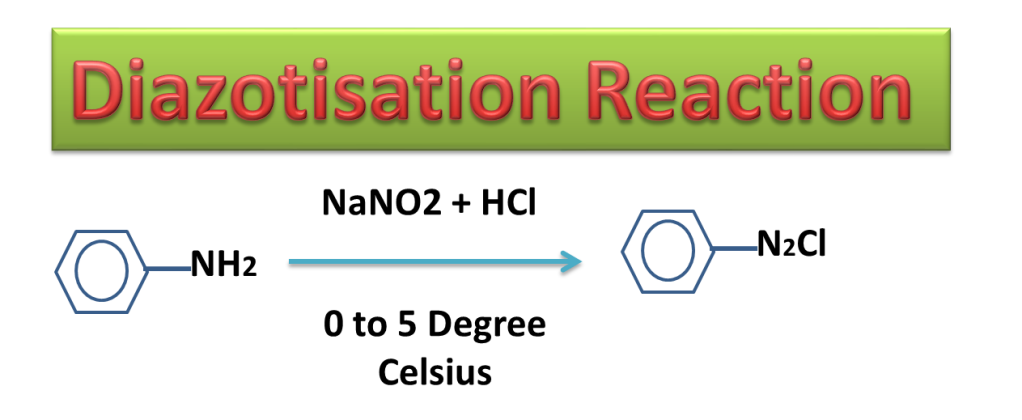
In diazotization Reaction, The aniline is treated with nitrous acid ( a mixture of sodium nitrite and hydrochloric acid) at temperature 00 to 50 Celsius ( 273 K to 278 K ) to produce diazonium chloride.
Nitrous acid is produce in the reaction mixture by treating NaNO2 with HCl
NaNO2 + HCl —>HNO2 + NaCl
Diazonium salt is highly unstable and can explode at little higher temperature therefore it is prepared at lower temperature (00 to 50 Celsius).
Diazonium salt can not be separated and product mixture is used for further reaction because diazonium salt is highly unstable and explode on distillation (on heating).
Diazonium salt is very much important in organic synthesis as for preparation of large number of organic compounds, it is precursor (Reactant).
The WURTZ REACTION was named after Charles Adolphe Wurtz. Wurtz reaction is a coupling reaction in organic chemistry, organometallic chemistry and inorganic chemistry. वुर्टज अभिक्रिया का नाम चार्ल्स एडॉल्फ वुर्टज के नाम पर रखा गया था। वुर्टज अभिक्रिया अभिक्रिया कार्बनिक रसायन विज्ञान, कार्ब धात्विक (ऑर्गोमेटेलिक) रसायन विज्ञान और अकार्बनिक रसायन विज्ञान में एक युग्मन अभिक्रिया है।
In Wurtz reaction two alkyl halides are reacted with sodium metal in dry ether solution to form a higher alkane. In this reaction alkyl halides are treated with sodium metal in dry ethereal (free from moisture) solution to produce higher alkanes. WURTZ REACTION is used for the preparation of higher alkanes containing even number of carbon atoms. वुर्ट्ज अभिक्रिया में दो ऐल्किल हैलाइडों को सोडियम धातु के साथ शुष्क ईथर विलयन में अभिक्रिया करके एक उच्च ऐल्केन बनाया जाता है। इस अभिक्रिया में ऐल्किल हैलाइडों को सोडियम धातु के साथ शुष्क ईथर (नमी से मुक्त) विलयन में उपचारित किया जाता है ताकि उच्च ऐल्केन प्राप्त हो सकें। वुर्ट्ज अभिक्रिया का उपयोग कार्बन परमाणुओं की सम संख्या वाले उच्च एल्केन्स की तैयारी के लिए किया जाता हैI
Advanced Knowledge:- Other metals for example silver, zinc, iron, activated copper, indium and a mixture of manganese and copper chloride have also been used in the Wurtz coupling reaction. उच्च ज्ञान:- अन्य धातुओं जैसे चांदी, जस्ता, लोहा, सक्रिय तांबा, इंडियम और ( मैंगनीज और तांबा क्लोराइड का मिश्रण) भी वर्टज़ युग्मन अभिक्रिया में उपयोग किया जाता है।
Acoupling reaction is that where two fragments of two molecules are joined together with the help of a metal catalyst. युग्मन अभिक्रिया वह होती है जिसमें दो अणुओं के दो टुकड़े एक धातु उत्प्रेरक की सहायता से आपस में जुड़ जाते हैं।
Fittig Reaction:-In this reaction, two aryl halides are coupled in presence of sodium metal in dry ether or tetrahydrofuran (THF) to furnish biaryls or biphenyls.
Wurtz Fittig Reaction:-The Wurtz–Fittig reaction is the chemical reaction of aryl halides with alkyl halides and sodium metal in the presence of dry ether to give substituted aromatic compounds.वर्ट्ज़-फिटिग अभिक्रिया ऐरिल हैलाइडों की ऐल्किल हैलाइडों और सोडियम धातु के साथ शुष्क ईथर की उपस्थिति में प्रतिस्थापित aromatic यौगिक देने के लिए रासायनिक अभिक्रिया है।
Mechanism of Wurtz Reaction:-
The reaction consists of a metal–halogen exchange involving the radical species R· (as in the formation of a Grignard reagent) with formation of carbon–carbon bond. प्रतिक्रिया में एक धातु-हैलोजन विनिमय होता है जिसमें कार्बन-कार्बन बंधन के गठन के साथ एल्काइल मुक्त रेडिकल प्रजाति (R ·) शामिल होता है। (जैसा कि ग्रिग्नार्ड अभिकर्मक के निर्माण में होता है)
Step-1 :- One electron from the metal is transferred to the halogen to produce a metal halide and an alkyl radical. चरण -1:- धातु से एक इलेक्ट्रॉन को हलोजन में स्थानांतरित करके एक धातु हैलाइड और एक अल्काइल रेडिकल का उत्पादन किया जाता है।
Step-2:- Now the alkyl radical accepts an electron from another metal atom to form an alkyl anion ( Carbanion). चरण -2:-अब अल्काइल रेडिकल एक अन्य धातु परमाणु से एक इलेक्ट्रॉन को एक अल्काइल आयन (कार्बनियन) बनाने के लिए स्वीकार करता है।
Step-3:-In last step, the nucleophilic carbon of the alkyl anion displaces the halide in an SN2 reaction, forming a new carbon–carbon covalent bond. चरण -3:-अंतिम चरण में, एल्काइल आयन का न्यूक्लियोफिलिक कार्बन SN2 प्रतिक्रिया में हैलाइड को विस्थापित करता है, जिससे एक नया कार्बन-कार्बन सहसंयोजक बंधन बनता है।
Comparison of these three reaction:- इन तीनों अभिक्रियाओं की तुलना:-
Wurtz’s Reaction R-X +Na + Na X-R –> R-R +Na X R = Alkyl Group (e.g. CH3-, C2H5– ….) Ph = Phenyl ( C6H5-)
Wurtz’s Reaction Ph-X + Na + Na + X-R –> Ph-R + NaX
Wurtz-Fittig’s Reaction Ph-X + Na + Na + X-Ph –> Ph-Ph + NaX
Advantage of Wurtz Reaction:- Wurtz coupling is useful in closing small, ( especially three-membered) rings. e.g. -Bicyclobutane was prepared this way from 1-bromo-3-chlorocyclobutane in 95% yield. वुर्टज अभिक्रिया का लाभ:- वुर्टज युग्मन छोटे, (विशेष रूप से तीन-सदस्यीय) रिंगों को बंद करने में उपयोगी है। जैसे 1-ब्रोमो-3-क्लोरोसाइक्लोब्यूटेन से 95% उपज में इस तरह से बाइसाइक्लोब्यूटेन तैयार किया गया था।
Limitations of the Wurtz reaction:- 1.Wurtz reaction is not used generally used because of side reactions. It has limited use to the synthesis of symmetric alkanes. आमतौर पर साइड रिएक्शन के कारण वुर्टज अभिक्रिया का उपयोग नहीं किया जाता है। सममित अल्केन्स के संश्लेषण के लिए इसका सीमित उपयोग है। 2.If two dissimilar alkyl halides are taken as reactants, then the product is a mixture of alkanes that is often difficult to separate by fractional distillation as the differences between the boiling points of the products are very low. यदि दो असमान ऐल्किल हैलाइडों को अभिकारकों के रूप में लिया जाता है, तो उत्पाद ऐल्केनों का मिश्रण होता है जिसे भिन्नात्मक आसवन द्वारा अलग करना प्रायः कठिन होता है क्योंकि उत्पादों के क्वथनांकों के बीच का अंतर बहुत कम होता है। 3.Wurtz reaction fails in case of tertiary halides. तृतीयक हैलाइड के मामले में वुर्टज अभिक्रिया विफल हो जाती है। 4.Methane can not be obtained by this method. इस विधि से मीथेन प्राप्त नहीं किया जा सकता है। 5.A side reaction occurs to produce an alkene due to involvement of free radical species. This side reaction becomes more significant when the alkyl halides are bulky at the halogen-attached carbon atom. मुक्त मूलक प्रजातियों की भागीदारी के कारण, एक ऐल्कीन उत्पन्न करने के लिए एक पार्श्व अभिक्रिया होती है। यह पार्श्व अभिक्रिया तब और अधिक महत्वपूर्ण हो जाती है जब हैलोजन-संलग्न कार्बन परमाणु पर ऐल्किल हैलाइड भारी होते हैं। 6.Wurtz reaction has poor yield which is a consequence of multiple product formation. In the case of 1,3-dihalides, 1,4-dihalides, 1,5-dihalides, 1,6- dihalides, it leads to formation of cyclic products. In case of vicinal dihalides, alkenes are formed, whereas alkynes are formed in geminal dihalides. वुर्टज अभिक्रिया में मुख्य उत्पाद बहुत कम मात्रा में बनता है जो कई-उत्पाद निर्माण का परिणाम है। 1,3-डाइहैलाइड, 1,4-डाइहैलाइड, 1,5डाइहैलाइड, 1,6-डाइहैलाइड के मामले में, यह चक्रीय उत्पादों के निर्माण की ओर जाता है। विसिनल डाइहैलाइड में ऐल्कीन बनते हैं, जबकि ऐल्काइन जेमिनल डाइहैलाइड में बनते हैं।










 CHEMIGOD