What is d-d transition ? (From d & f block elements ) Answer:- The electronic transition between two energy levels of d orbital is called d-d transition. Movement of electron from one d orbital to other d orbital having different energy.
Where does d-d transition occur ? Ans:- d-d transition is found in complex compounds ( or Coordination compounds ). Complex compound is made up of two entities – one is central metal atom / ion and other is Ligand (electron donor molecule or atom or ion )
Why d-d transition occur in place of simple electronic transition occurs between different shells?
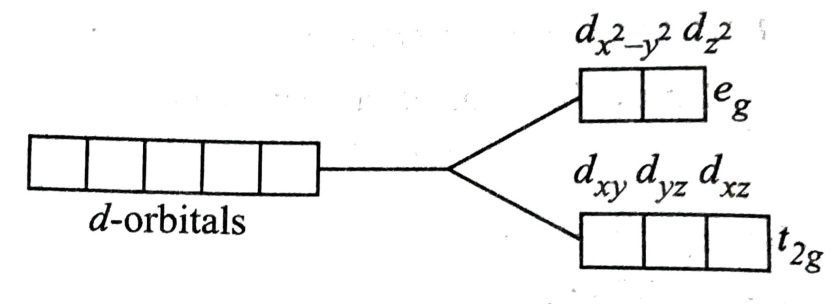
Answer:- In coordination / complex compounds d subshell containing five d orbitals split into two parts (t2g and eg ) under influence of ligand field. In octahedral complex / coordination compounds d subshell is splited into two energy level: one is of lower energy called t2g energy level containing three d orbital dxy, dyx and dzx and other is of higher energy level called eg energy level containing two d orbitals d x2-y2 and dz2
Why complex / coordination compounds are coloured ? In coordination / complex compound, When electron present in one of t2g orbital absorb fixed amount of energy ( absorb particular frequency or wavelength of white light ) and moves to one of eg orbital than complementary light is reflected which we see through our eyes. e.g. CuSO4.5H2O is blue in coloured, Sodium chromate is yellow in coloured. Sodium dichromate is Orange in coloured [Cu (H2O)4]2+ absorb at 600nm means Red colour and complementary colour we see is Green.
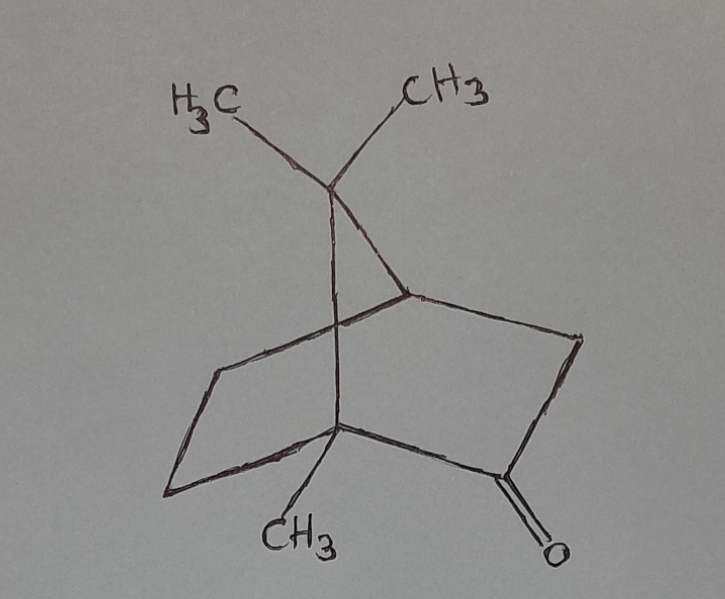
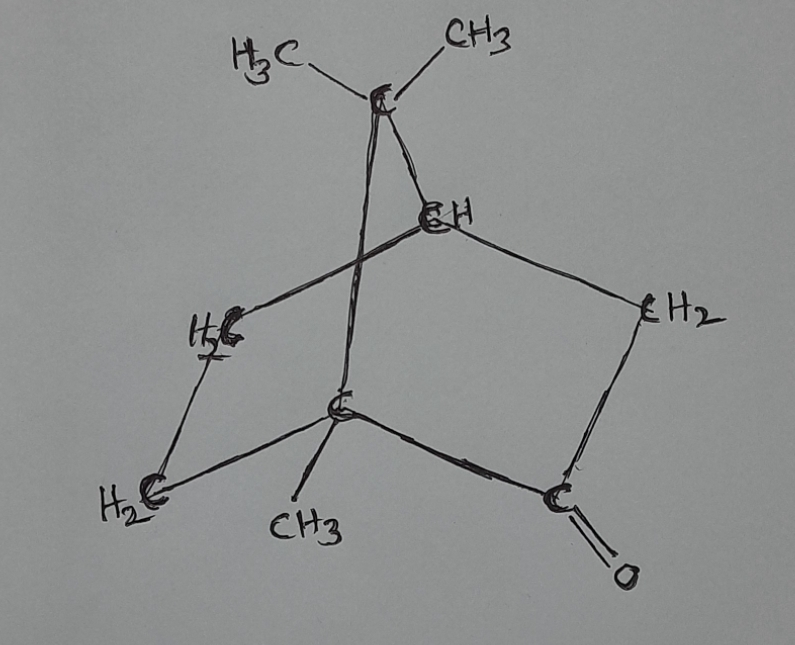
Camphor:- Formula:-( C10H16O ) Structure:- bicyclic ketone ( Bicyclic means compounds containing two rings.) Ketones is a functional group, in which one carbon has double bond with one oxygen and one-one single bond with other carbon atom.
Uses:- 1. It is burnt in worship. 2.As disinfectant, It produce lumps of carbon atoms which adsorb micro organism, particles of good or bad smell. 3.used on the skin as a painkiller in concentrations of 3% to 11%. 4.Camphor is used in many rub-on products to reduce pain related to cold sores, insect stings and bites, minor burns, and hemorrhoids. 5.It is used as one component of “amritdhara” which is used to apply on forehead to relieve from headache. 6. It is used in products such as Vicks Vapo Rub. 7.Warning:-Oral camphor is unsafe. It is also important not to apply camphor to broken skin, because it can enter the body quickly and reach concentrations that are high enough to cause poisoning. Source:- 1. Camphor is present in the volatile oils of camphor obtained from tree- Cinnamomum camphora ( Botanical Name ), or Camphor laurel 2.These days, camphor is usually manufactured from turpentine oil. Process of making:- Camphor is obtained by using steam distillation of wood, twigs and bark of the Camphor tree, followed by purification and sublimation.
Occurrence of Camphor Tree:- In India, South east China, Taiwan, Japan, Mangolia, Indonesia. Height:- 50- 60 feet ( 15 -18 metre )
Age :- 150 Years
Shape:- Umbrella
Width:- Up to 15 m
कपूर / या कर्पूरम :- फॉर्मूला:- (C10H16O) संरचना:- द्विचक्रीय कीटोन ( द्विचक्रीय वलय का अर्थ है दो वलय वाले यौगिक) कीटोन एक कार्यात्मक समूह है, जिसमें एक कार्बन का एक ऑक्सीजन के साथ दोहरा बंधन होता है और अन्य कार्बन परमाणुओं के साथ एक-एक एकल बंधन होता है।
उपयोग:- 1. इसे पूजा में जलाया जाता है। 2. निस्संक्रामक के रूप में, यह कार्बन परमाणुओं की गांठें उत्पन्न करता है जो सूक्ष्म जीवों, अच्छी या बुरी गंध के कणों को सोख लेती हैं। 3.त्वचा पर दर्द निवारक के रूप में 3% से 11% की सांद्रता में उपयोग किया जाता है। 4.इसका उपयोग कई रगड़-उत्पादों में ठंड घावों, कीड़े के डंक और काटने, मामूली जलन और बवासीर से संबंधित दर्द को कम करने के लिए किया जाता है।
5.यह “अमृतधारा” के एक घटक के रूप में प्रयोग किया जाता है, जिसे सिर दर्द से राहत पाने के लिए माथे पर लगाने के लिए प्रयोग किया जाता है। 6. इसका उपयोग विक्स वेपो रब जैसे उत्पादों में किया जाता है। 7. चेतावनी:- मुह के द्वारा इसे लेना असुरक्षित हैI यह भी महत्वपूर्ण है कि टूटी हुई त्वचा पर कपूर न लगाएं, क्योंकि यह शरीर में जल्दी से प्रवेश कर सकता है और इतनी अधिक मात्रा में सांद्रता तक पहुँच सकता है कि विषाक्तता पैदा कर सकता है। स्रोत:- 1.कपूर पूर्व सिनामोमम कपूर (वानस्पतिक नाम) या कपूर लॉरेल के वाष्पशील तेलों में मौजूद होता है।
2.आजकल, कपूर आमतौर पर तारपीन के तेल से बनाया जाता है। बनाने की प्रक्रिया:- 1.कपूर की लकड़ी, टहनियों और छाल के भाप आसवन का उपयोग करके कपूर प्राप्त किया जाता है, इसके बाद शुद्धिकरण और उर्ध्वपातन किया जाता है।
कपूर के पेड़ की उपस्थिति:- भारत, दक्षिण पूर्व चीन, ताइवान, जापान, मंगोलिया, इंडोनेशिया
Investigatory Project for Class 11 and 12 Chemistry and Biology CBSE Students
Aim:- To investigate the chloride content in milk. Apparatus:- Conical flask, burette, pipettes etc. Reagents:- Ferric alum indicator: In 10% nitric acid, prepared by boiling excess of iron alum, cooling and filtering; Potassium thiocyanate: 0.05 N, (standardized against standard potassium chloride.), Silver nitrate: Approximately 0.05 N, Concentrated nitric acid. Theory:- The normal range of chloride content
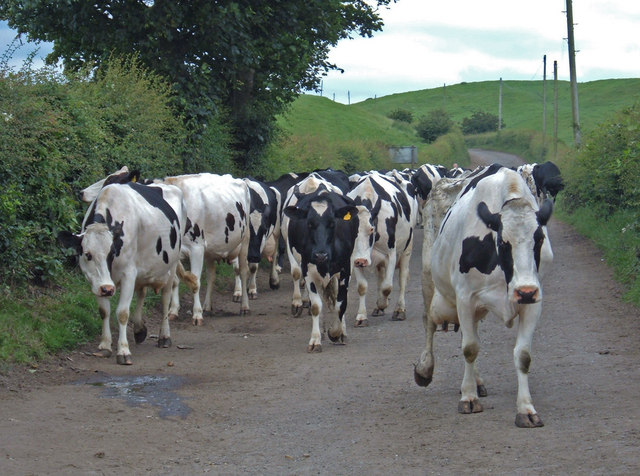
in cow’s milk is 80-140 mg/100 ml and in buffalo’s milk is 60-70 mg/100 ml.
Determination of chloride content in milk can be used as a means of detecting abnormal milk such as infected udders, colostrum and late lactation milk which are usually high in chloride content. Values of chloride content higher than 0.14% (140 mg/ 100 ml) in milk indicate the presence of abnormal milk.
Estimation of chloride content in milk is based on argentometric titration (Volhard’s method). In this method a known excess quantity of standard AgNO3 solution is added to the known volume of milk. The chloride present in milk reacts with silver nitrate and forms white precipitate of insoluble silver chloride. The unused AgNO3 (which is present in excess) is back titrated against standard potassium thiocyanate (KCNS) in presence of concentrated HNO3 using ferric alum as indicator. End point of titration is the first appearance of orange-red colour which persists for at least 15 seconds. End point of titration is not clearly visible in sample titration with potassium thiocyanate (KCNS). HNO3 is added to the system to dissolve the interfering casein and also to make the solution acidic so as to keep the AgCI in the precipitated form.
Reactions:-
CI- + Ag+ —–》 AgCI (until all Cl- is complexed)
Ag+ + SCN- ——-》 AgSCN (to quantitate silver not complexed with chloride)
SCN- + Fe3+ —–》 FeSCN (orange-red when there is any SCN- not complexed to Ag+)
Preparation of reagents:- A. Potassium thiocyanate -0.05 N Solution
w = M x GMM X V ( in ml)/ 1000 w = N x GEM X V ( in ml)/ 1000
w = 0.05 N x 97 g mol- X 100 ml / 1000 = 0.485 g
Dissolve 0.485 g of in water present in 100 ml volumetric flask and make up with water up to the ring. B. Silver nitrate: Approximately 0.05 N Solution
w = M x GMM X V ( in ml)/ 1000 w = N x GEM X V ( in ml)/ 1000
w = 0.05 N x 170 g mol- X 100 ml / 1000 = 0.85 g
Dissolve 0.85 g of in water present in 100 ml volumetric flask and make up with water up to the ring.
Procedure:- Take 10 g of the sample, accurately weighed in a 250 ml of Erlenmeyer flask. To this add 10 ml of silver nitrate solution and 10 ml of concentrated nitric acid. Shake the content. Digest the mixture until reddish brown fumes are evolved. Cool the flask and add 1 ml of saturated iron alum solution. Determine the excess of silver nitrate by titrating with the standard potassium thiocyanate until the first appearance of an orange red colour that persists for 10 seconds. In the same manner, determine the volume of the standard thiocyanate solution equivalent to 10 ml of silver nitrate using the same volumes of reagents and water.
S.N.
Sample of milk
X = volume in ml of the standard potassium thiocyanate solution required by the blank
Y = volume in ml of the standard potassium thiocyanate solution required by the sample
{X- Y }
Chloride, % by weight = 0.01773 (Y – X)
Chloride as sodium chloride, % by weight = 0.02923 (Y- X)
1
Cow milk of healthy cow
2
Cow milk with infected udders
3
Cow milk with colostrum
4
Cow milk with late lactation
5
Buffalo milk of healthy Buffalo
6
Cow milk with infected udders
7
Cow milk with colostrum
8
Cow milk with late lactation
Calculations:- Chloride, % by weight = 0.01773 (Y – X)
Chloride as sodium chloride, % by weight = 0.02923 (Y- X) Where,
X = volume in ml of the standard potassium thiocyanate solution required by the blank, and Y = volume in ml of the standard potassium thiocyanate solution required by the sample.
Resut:-The samples of milk of cow/ Buffalo with infected udders, colostrum and late lactation cases have more chloride content.
Practical Examination Sample Question Paper 1st Term-II 2022 CBSE, India —-‐–‐—————————————————————————————————————- AISSCE ( CHEMISTRY PRACTICAL EXAMINATION ) 2022 Subject:- Chemistry Subject Code: – 043 Name of School :- School Code:- Time :- 3 hours M.M. : 15 Instructions : 1.Question number 1,2 and 3 to be performed in the lab. 2.All question are compulsory. 3.Perform the given experiment and report that in examination note book systematically. 4.Use all precaution measures while working in the lab and protect your note book from chemicals, burn etc. Questions are as follows- Q1. Find out the molarity and strength in g/L of given unknown KMnO4 solution by using M/20 Mohr salt solution. ( Solutions of different Concentrations should be given to students, therefore prepare at least two to four of solution of KMnO4 should prepare ) AND / OR Find out the molarity and strength in g / l of given unknown KMnO4 solution by using M/20 Oxalic Acid solution. (4) Q2. To detect the presence of one cation and anion in given salt. (4) Q3. Identify the functional group present in the given organic compound. (2) Q4. Investigatory Project and viva –voice (5) Sign of Internal Examiner ….……………… Sign of External Examiner……………………….. Name of Internal Examiner………………… Name of External Examiner……………………… Internal Examiner number ……………….. External Examine number……………………… ( Note:-1.Colourless salts should be preferred . 2.Distribute salts randomly. 3.Try to give cations and anions from each group 4. Distribute organic functional groups randomly.) Alok Sharma , PGT Chemistry

 CHEMIGOD